She was elected to serve CD3. Here’s what she’s actually been doing with her portfolio since January 2025 — fully sourced, no exaggeration needed.
TOTAL TRADES
TOTAL VOLUME
COMPANIES
MONTHS IN OFFICE
Most people in the Third District don’t have a financial adviser making dozens of trades on their behalf while they’re at work. They have a paycheck, a mortgage, and a lot of questions about whether the people in Washington are looking out for them or for themselves. When it comes to Kelly Morrison, the public record gives those questions plenty of material.
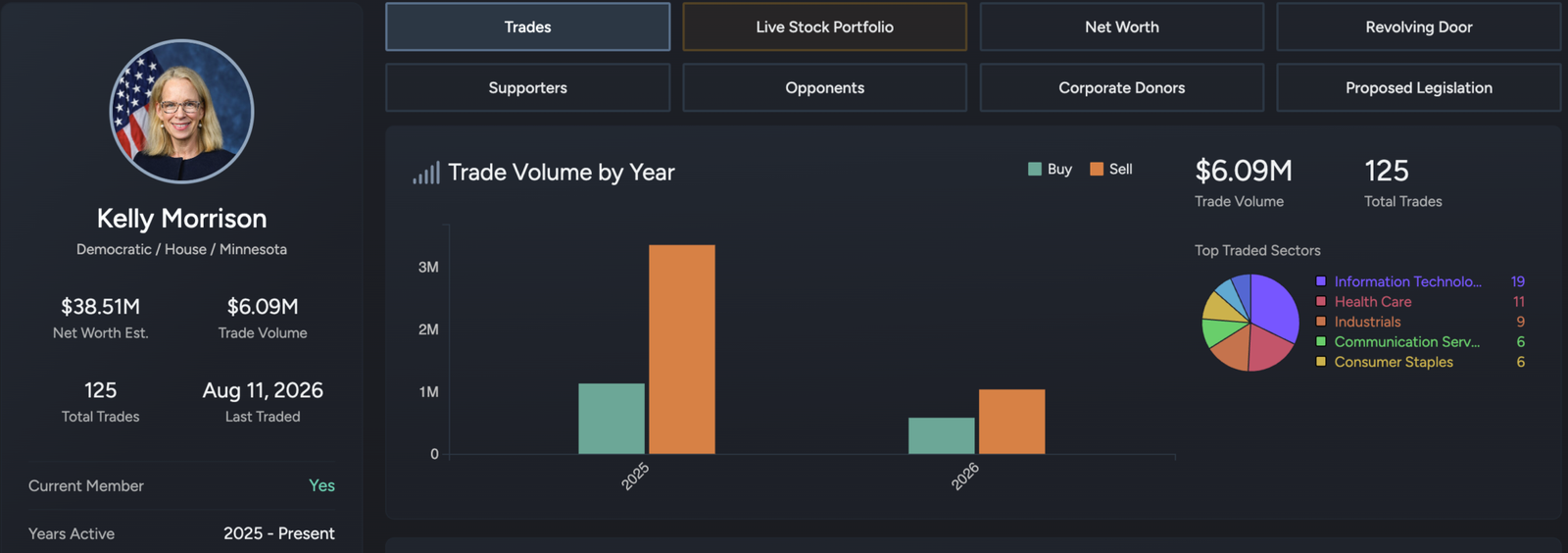
Morrison was sworn in at the start of 2025. Reporting by the Minnesota Star Tribune found she executed 106 trades in her first 16 months in Washington, along with private investments running into the high six figures. A separate NOTUS review counted about 90 trades during the 119th Congress at that point, which made her one of Congress’s more active traders.
That is a lot of activity for a member of Congress whose job is to vote on defense spending, health policy, and regulation. Her office has said her portfolio is run by an investment adviser. That may be true, but the disclosure forms carry her name, not her adviser’s.

The STOCK Act of 2012 requires members of Congress to report their trades publicly within 45 days. According to a NOTUS review of congressional financial records, Morrison failed to properly disclose eight trades worth between $1.41 million and $2.91 million. Her office blamed the delays on her investment manager and said the reporting process had been updated.
Transparency rules exist so voters can see who benefits from decisions in Washington. When millions of dollars in trades show up late, that purpose is defeated.
Morrison was months — in one case more than a year — late disclosing eight financial trades worth $1.41 million to $2.91 million, mostly stakes in Andersen Corporation. The STOCK Act requires disclosure within 45 days regardless of who executes the trade. Her office paid the standard $200 fine.
Source: NOTUS, Minnesota Star Tribune
| Company | What it does | Action | Date | Amount |
|---|---|---|---|---|
| Saronic Technologies | Autonomous Navy warships | Buy | Mar 11, 2026 | $15,001–$50,000 |
| Saronic Technologies | Autonomous Navy warships | Sell | May 4, 2026 | $15,001–$50,000 |
| Star Catcher IndustriesDEFENSE | Space power grid; lists “national security” as a core market; Air Force SBIR award | Buy | Apr 6, 2026 | $15,001–$50,000 |
| Star Catcher Industries | Space power grid | Sell | May 4, 2026 | $15,001–$50,000 |
| Honeywell Aerospace | Aircraft components; serves military, defense & space platforms | Exchange (spinoff) | Jun 29, 2026 | $15,001–$50,000 |
| Hermeus Corp | Hypersonic aircraft | Sell | May 4, 2026 | $15,001–$50,000 |
| StarCloud | Orbital AI data centers | Holding | 2026 | Undisclosed range |
| Flux | AI hardware | Buy | 2026 | Part of $1.4–2.9M late-disclosed trades |
| Broadcom (AVGO) | AI & semiconductor chips | Buy | Mar 21 & Apr 11, 2025 | $1,001–$15,000 each |
| Meta Platforms (META) | AI & social media | Buy | Mar 24 & Apr 11, 2025 | $15,001–$50,000 each |
After the scrutiny built, Morrison changed course. She announced she was beginning to divest from all public and private companies and would no longer own individual stocks. The Star Tribune’s reporting highlighted private holdings including Saronic, Varda Space Industries, Starcloud, and Advanced Machine Intelligence, and noted that she had not committed to a timeline for selling.[1]
Disclosures show she sold her stakes in Saronic and Hermeus Corp, a high-speed aircraft manufacturer, on May 4, 2026.[2]
I’ll give her credit for ending the practice. But she sold after the reporting, the ethics criticism, and the headlines, not before. A representative who had been committed to this principle from the start would never have bought the stock.
Saronic is not an abstract investment. In June, after an Army Apache helicopter went down off the coast of Oman, reportedly from Iranian action, the Navy’s Task Force 59 used a Saronic Corsair unmanned boat to pick up the two American pilots.[3][4] The rescue took about two hours, and both pilots were in stable condition.[3] It was the first known use of an unmanned vessel for a search and rescue mission.[3] The same boat was used again in July in a strike on an Iranian naval base.[5]
Morrison had sold her stake by then.[2] But she bought it nine days into the war, in a company whose products were about to become part of it.[6] Families who are asking what this war is costing them deserve a representative who wasn’t invested in the equipment being used to fight it.
Morrison has been publicly opposed to the war in Iran.[7] Yet nine days after it began, she bought up to $50,000 in a company that builds warships for the Navy. She is a sitting member of Congress who votes on the defense budget and on the spending that keeps contractors like Saronic in business.
Her office says she had no prior knowledge of the trade and that her investment adviser made it.[7] Maybe so. But that leaves a question she has to answer: which is it? Either she knew what she was buying and did it anyway, or she doesn’t know what is in her own portfolio. Neither answer is acceptable from someone who votes on war and defense spending.
And the timeline doesn’t help her. She bought on March 11 and held until May 4. That is 54 days, nearly eight weeks, while American troops were in combat.[2][6] A member of Congress who truly opposed this war would have dumped the stock the moment she found out. She sold only after the reporters started asking.

When she announced her divestment, her office said Morrison supports legislation to ban elected officials from owning individual stocks.
On July 22, the House got a chance to act. The Stop Insider Trading Act would bar lawmakers, their spouses, and dependent children from buying individual stocks. It also requires them to disclose planned sales at least seven days in advance. It passed 232-198, with 13 Democrats voting in favor.
From Pine Island to Hermantown to Monticello, Minnesotans have spent the past year fighting data centers. Opposition has become a familiar scene across the state, in small communities and big cities, ruby red and indigo blue alike.[1] Wright County passed the first county emergency moratorium on new data centers in May.[2] Residents cite water use, electricity, and noise.[3]
Kelly Morrison put money on the other side. She invested between $15,001 and $50,000 in Starcloud, a Redmond, Washington company developing data centers in orbit and valued at $1 billion.[4] Starcloud launched its first satellite in November 2025 with an Nvidia H100 chip, which it describes as the first data-center-class GPU ever operated in space.[5][6]
Starcloud was one of 28 private companies where Morrison invested between $483,000 and $1.45 million, according to a Star Tribune analysis. Most of that money went to venture-backed firms.[4]
Space is not Pine Island, and her defenders will say so. But the bet is the same one: that demand for AI computing keeps growing, and the people who own a piece of it do well. Morrison’s office says her trades were made through a financial adviser.[4] Minnesotans living next to these projects deserve to hear whether she supports the buildout their neighbors are fighting.

Hermeus builds uncrewed high-speed aircraft. Its own aircraft roadmap describes a “Mission Plane” it says is built for the American warfighter, and a reusable hypersonic drone called Darkhorse designed for defense and national security missions.[1] On April 7, Bloomberg reported that Hermeus had raised $350 million to build the fastest uncrewed aircraft ever for the U.S. Department of Defense, a round that made it a billion-dollar company.[2]
Kelly Morrison invested in Hermeus on March 2, 2026, according to a report of her disclosure filing.[3] The war with Iran had begun two days earlier, on February 28.[4] That means she held the stake through the April funding round. She sold it on May 4, valued between $15,001 and $50,000.[5]
May 4 is the same day she sold her stake in Saronic Technologies, the autonomous warship company she bought nine days into the war.[5][6] Two defense startups, both bought in the first two weeks of the war, both sold on the same day, after the questions started.
Nothing in the public record shows she traded on inside information, and her office says her portfolio is managed by an investment adviser.[6] But voters can still ask the plain question. A member of Congress who says she opposes this war ended up owning pieces of two companies building weapons for it, and a portfolio like that does not stay hands-off forever. Why was it set up that way, and why did it take reporters asking to change it?

Her defenders will say the bill was flawed, and they have a real argument. The bill lets members keep stocks they already own. It exempts the president, and it was packaged with a voter ID requirement. Senate Democrats blocked it on a 53-47 party-line vote on September 30.
My answer is this. Supporters called the House bill the most significant action Congress had taken to restrict stock trading by its members, and thirteen Democrats decided it was worth voting for. A member who says she wants a ban, and who has just been through a public ethics controversy over her own trades, could have joined them. She didn’t. If the bill was not enough for her, she can tell voters what she is doing to pass one that is.
I posted a video asking Congresswoman Morrison to write a $100,000 check to the families of the service members affected by the Iran war. The suggestion was that money tied to a defense contractor in the middle of that conflict should go to the people who bore its cost. As of this writing, she has not responded.
She has no legal obligation to do it. But after being questioned about her Saronic trade, a direct and public gesture would have shown she understands why people were upset. Silence suggests she doesn’t.
@bass.for.congress Let"s talk about fraud. You know, seeing free has had numerous amounts of autistic companies, nonprofits and for-profits. Just come out of the woodworks and there"s no accountability. Cheques are being written. Our tax dollars are going down the drain and nobody"s being held accountable. And we need to help the children not steal money from them. #tylerbassforcongress #tbassforcongress #tbassagainstfraud #mnfraud
♬ original sound - Bass For Congress
| Company | Trade | Date | Value |
|---|---|---|---|
| Target Corporation (TGT) | Sell | Mar 21, 2025 | $100,001–$250,000 |
| D.R. Horton (DHI) | Sell | Mar 20, 2025 | Undisclosed range |
| CACI International (CACI) | Sell | Mar 20, 2025 | Undisclosed range |
| Merck & Co. (MRK) | Sell (partial) | Mar 20, 2025 | Undisclosed range |
| ResMed (RMD) | Sell (full) | Apr 28 & Jun 4, 2025 | $1,001–$15,000 |
| UPS | Sell (full) | Jun 4, 2025 | $1,001–$15,000 |
| Zebra Technologies (ZBRA) | Sell (full) | Jun 4, 2025 | $15,001–$50,000 |
| Nike (NKE) | Sell (full) | Jun 4, 2025 | $1,001–$15,000 |
| Houlihan Lokey (HLI) | Sell (full) | Jun 4, 2025 | $1,001–$15,000 |
| Johnson & Johnson (JNJ) | Sell | Aug 19, 2025 | $1,001–$15,000 |
| Thermo Fisher Scientific (TMO) | Sell | Aug 19, 2025 | $15,001–$50,000 |
| Accenture (ACN) | Sell | Aug 19, 2025 | $15,001–$50,000 |
| Verizon (VZ) | Sell | Aug 19, 2025 | $1,001–$15,000 |
| Ajg (Arthur J. Gallagher) | Sell (full) | Mar 8, 2026 | $1,001–$15,000 |
| Magnum Ice Cream Co (MICC) | Sell (full) | Mar 8, 2026 | $1,001–$15,000 |
| Mobility Global Inc. (MBGL) | Sell | Aug 11, 2026 | $1,001–$15,000 |
| Solstice Advanced Materials (SOLS) | Sell | Aug 11, 2026 | $1,001–$15,000 |
| Urban Sky | Buy | Jan 6, 2025 | Up to $50,000 |
| Aero Engineering Holdings LLC | Buy | Jan 27, 2025 | $50,001–$100,000 |
The Third District deserves a representative whose only financial interest in a vote is the same as yours: how it affects the country. So here is my commitment:
Kelly Morrison says she believes in these principles. I’m asking voters to judge her by what she did: the trades, the late filings, and the vote.
Morrison ranked 45th among all 535 members of Congress for total trades over a recent three-year stretch. For comparison: Sen. Tina Smith reported 13 trades in three years (made by her husband), Rep. Pete Stauber had one, and the rest of the Minnesota delegation had none in that period.
Source: Minnesota Star Tribune, Capitol Trades